
Last updated:
The global GPU market was valued at approximately $23.57 billion in 2025. By 2034, it is projected to cross $97 billion, driven by AI workloads, gaming and content creation demand. That growth sounds exciting until you try to actually buy a graphics card in 2026.
Right now, the market is being hit from multiple directions at once. NVIDIA’s RTX 50 series launched with supply constraints. The ongoing AI boom triggered a global GDDR7 memory shortage that pushed GPU prices well above MSRP. ASUS and MSI have already raised prices on custom RTX 5090 cards to $3,000 to $4,200 in several markets. AMD’s RX 9000 series launched with genuine promise, but availability has been inconsistent.
In this environment, picking the right GPU brand matters more than it did two years ago. The wrong choice means overpaying for a cheap cooler or buying from a brand with poor warranty support in your region. The right choice means getting the most performance and longevity from every dollar you spend.
This guide tells you exactly what changes between GPU brands, which brands are worth trusting in 2026, and how to make a smart buying decision during one of the most turbulent GPU markets in years.
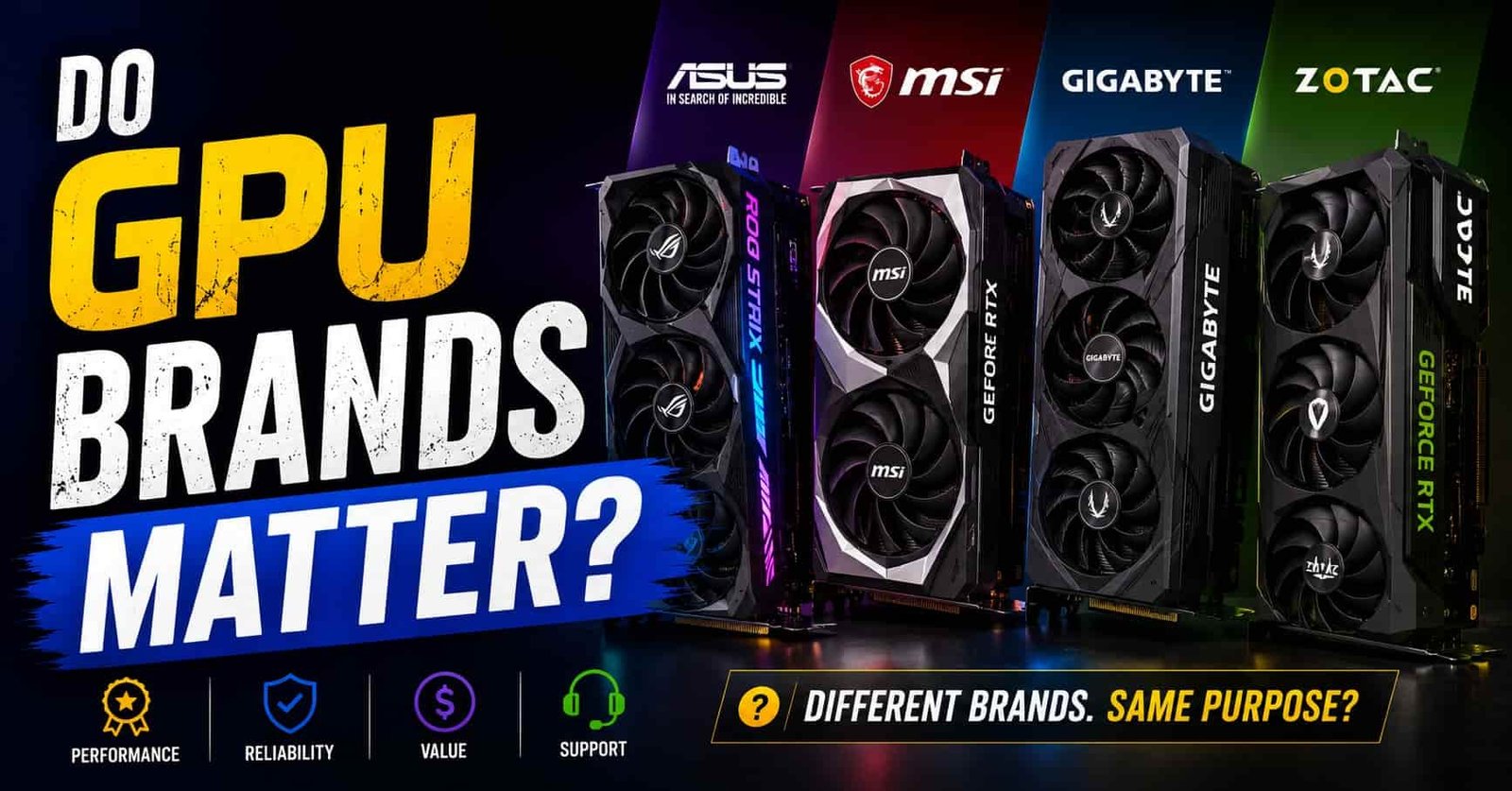
Do GPU Brands Matter?
Yes. Not for raw frame rates in most cases. But for everything around the frame rate. Every RTX 5070 uses the same NVIDIA Blackwell GB205 chip. Every RX 9070 XT uses the same AMD RDNA 4 Navi 48 chip. NVIDIA and AMD design the silicon. Third-party manufacturers called AIBs (Add-in Board partners) design the PCB, cooling system, power delivery, and final product.
What your brand controls is how well that chip performs over time. Under sustained gaming loads. In a hot room. During a four-hour stream. After two years of daily use. That is where the brand gap shows up clearly.
In 2026, there is one more reason brand selection matters: price. With GPU prices rising due to memory shortages, the cheapest AIB card and the most expensive version of the same chip can vary by $150 or more. You need to know exactly what that premium is and what it is not buying you.
Why do the same GPUs come from different brands
NVIDIA and AMD GPU Partners
NVIDIA supplies its Blackwell GPU chips to licensed AIB partners, including ASUS, MSI, Gigabyte, Zotac, PNY, Palit, and Inno3D. AMD supplies RDNA 4 chips to Sapphire, PowerColor, XFX, Gigabyte, ASUS, and ASRock. These partners receive bare GPU dies from TSMC’s fabrication lines and build the complete product around them.
NVIDIA enforces strict performance limits on its AIB partners. This means RTX 50 series cards from different brands hit nearly identical gaming benchmark numbers. AMD gives its partners significantly more flexibility. This is why RX 9070 XT cards from different brands show up to a 6 percent FPS spread in titles like Black Myth: Wukong, according to TechSpot’s 14-card roundup.
What AIB Partners Actually Change
This is where the real product differentiation lives. PCB quality and VRM design. Premium brands use more power phases and higher-grade capacitors. Under heavy overclocking or sustained AI workloads, this affects both headroom and long-term component stability.
Cooling system design. A basic dual-fan card and a triple-fan vapor chamber card of the same GPU chip can run 10 to 12 degrees Celsius apart under full load. That temperature gap directly affects boost clock consistency.
Factory overclock. AMD partners can push their RX 9070 XT cards to 3,060 MHz boost versus AMD’s reference specification. Sapphire Nitro Plus and ASUS TUF both hit this target in independent testing.
Fan tuning and noise management. The difference between a cheap sleeve-bearing fan and a premium dual ball-bearing fan shows up in noise measurements and fan longevity over two to three years.
What Changes Between GPU Brands?
Cooling Systems
This is the single most impactful difference between GPU brands at identical price points.
TechSpot’s comprehensive RX 9070 XT roundup tested 14 AIB cards and found a tight but real thermal spread. Most cards ran between 80 and 85 degrees Celsius under sustained load. The best performers, including the XFX Mercury and Sapphire Nitro Plus maintained lower hotspot temperatures while keeping fan speeds low and clock speeds high simultaneously. That combination is the hallmark of well-engineered cooling.
Sapphire’s Nitro Plus RX 9070 XT uses a nickel-plated copper base with a 16-phase power design. ASUS TUF RX 9070 XT runs seven heatpipes into a large aluminum fin array with three Axial-Tech fans. Both hit 3,060 MHz boost clocks consistently. Budget variants of the same card use simpler heatsinks and show throttling behavior under sustained load.
Noise Levels
Budget AIB cards use cheaper fan bearings with more aggressive fan curves. The result is an audible fan ramp-up during gaming that premium cards handle far more gracefully.
MSI’s Zero Frozr technology stops fans completely at low GPU loads. ASUS and Gigabyte offer similar idle-stop modes. In a streaming or recording setup, these differences are immediately obvious in background noise levels.
Factory Overclocks
For the NVIDIA RTX 50 series, the brand factory overclock difference is very small. NVIDIA controls the performance ceiling tightly across AIB partners. For the AMD RX 9000 series, the story is different. Cards with higher power limits and better VRM designs from Sapphire, PowerColor, and ASUS consistently pull ahead by 3 to 6 percent in sustained performance benchmarks.
Build Quality and Components
Premium cards from ASUS, MSI and Sapphire use military-spec capacitors, full-cover metal backplates, and high-phase VRM designs. Budget options cut costs on every one of those components. For casual gaming in a well-ventilated case this rarely causes problems. For sustained AI inference runs or continuous streaming, this is where premium build quality justifies its cost.
Which GPU Brands Are Known for Reliability in 2026?
Sapphire is the definitive choice for AMD GPU cards. They manufacture exclusively for AMD, which gives them unmatched expertise in RDNA architecture. Their Nitro Plus line topped TechSpot’s 14-card RX 9070 XT roundup for overall package. Fan reliability data from long-term community reports consistently places Sapphire near the top for AMD cards.
ASUS holds the premium position across both NVIDIA and AMD. ROG Strix cards command the highest prices and deliver top-tier cooling. TUF Gaming cards offer nearly identical thermal performance at a more reasonable premium. Independent testing confirms ASUS uses better thermal paste application and more robust power delivery than the average AIB.
MSI delivers excellent value through its Gaming X Trio lineup. Quiet fan profiles refined fan curves and consistent boost clocks make MSI a top recommendation for builds where noise is a priority. Their RTX 50 series cards have received strong early reviews.
PowerColor is the most underrated brand in the AMD ecosystem. Their Red Devil RX 9070 XT reached the top tier of TechSpot’s roundup with a phase-change thermal pad on the GPU die that no other brand included at launch. It is a meaningful thermal engineering choice that most buyers overlook entirely.
Gigabyte has solid current-generation Aorus cards but carries historical baggage from documented capacitor issues in older GPU generations. Their Aorus Master and Elite lines compete respectably at the premium tier. Quality control has improved meaningfully but the brand reputation still shows in community trust surveys.
Zotac fills the compact PC segment well. Their Twin Edge line fits in cases where full triple-fan cards physically cannot. After EVGA’s 2022 exit Zotac expanded its North American presence and improved customer support operations.
ASRock produced one of the standout RX 9070 XT designs in their Taichi line. TechSpot’s roundup placed it among the top performers. The brand is newer to mainstream GPU attention but the Taichi’s strong debut earned real credibility.
XFX surprised observers in TechSpot’s roundup with their Mercury model leading the hotspot temperature charts. Their warranty service has also been impressive in independent evaluations, outperforming even ASUS on response time according to some sources.
Does GPU Brand Affect Gaming Performance?
For NVIDIA RTX 50 series cards, the honest answer is barely. NVIDIA’s strict AIB guidelines mean all RTX 5070 cards from any brand land within 1 to 3 FPS of each other in gaming benchmarks. The chip runs the game. The brand manages thermal conditions around the chip.
For the AMD RX 9000 series, the gap is real and measurable. TechSpot’s 14-card RX 9070 XT roundup found a 6 percent spread between the fastest and slowest cards in Black Myth: Wukong at 1440p. AMD allows partners to configure higher power limits, which directly enables higher sustained clock speeds. The Sapphire Nitro Plus, XFX Mercury and ASRock Taichi consistently led performance charts. The Sapphire Pulse and XFX Swift lagged notably behind despite using the same physical chip.
This is unique intelligence that most GPU brand articles miss entirely. If you buy AMD the brand you choose directly affects how fast your card runs in games. If you buy NVIDIA the brand you choose primarily affects how cool and quiet that performance runs.
Cheap vs Premium GPU Brands in 2026
The 2026 GPU market adds a new layer to this comparison. With GDDR7 memory prices rising sharply, the cheapest AIB cards are no longer as dramatically cheaper as they once were. The price gap between budget and premium AIB versions of the same chip has narrowed in percentage terms, even as absolute prices climbed.
This changes the value calculation. When a budget RX 9070 XT costs $700, and a Sapphire Nitro Plus costs $770, that $70 difference buys you meaningfully better cooling, a phase-count VRM advantage, better long-term fan reliability, and a cleaner power connector design. In 2023, the same $70 difference looked larger against a $400 reference card.
Premium AIB cards also hold resale value better. On secondhand markets, buyers pay more for ASUS ROG Strix and Sapphire Nitro Plus cards because the brand signals build quality. Budget AIB cards depreciate faster.
For buyers in South Asia, the Middle East and Southeast Asia where ambient temperatures regularly exceed 35 degrees Celsius, the premium cooler is not optional. It is essential. A budget cooler that runs 82 degrees in a 22-degree room will thermally throttle in a 38-degree room. This directly reduces game performance and stream stability.
Best GPU Brands for Different Users in 2026
For 1440p and 4K gaming on NVIDIA RTX 50 series: MSI Gaming X Trio or ASUS TUF Gaming. Both offer excellent cooling at rational price premiums over base AIB variants. The RTX 5070 Ti is the best value NVIDIA option at this resolution tier as of mid-2026.
For AMD RX 9000 series gaming, Sapphire Nitro Plus is the top pick overall. PowerColor Red Devil is the best alternative with its unique phase-change thermal pad. Both outperform cheaper variants by a measurable margin in sustained gaming.
For streaming and gaming simultaneously: ASUS ROG Strix or Sapphire Nitro Plus. The combined heat of game rendering and NVENC or AMF encoding demands the largest heatsink and best fan configuration you can afford.
For content creation and AI workloads: Sapphire Nitro Plus for AMD. ASUS ROG Strix for NVIDIA. Sustained 100 percent GPU loads in DaVinci Resolve, Blender renders, or local LLM inference require the thermal stability that only premium coolers provide reliably.
For compact and SFF builds: Zotac Twin Edge or PNY Slim line. PNY’s RTX 5080 Dual-Fan Slim was announced at CES 2026 specifically for mATX builds using an advanced vapor chamber in a compact form factor. Card length matters critically in small cases. Always verify dimensions before purchasing.
For budget buyers in 2026: The Intel Arc B580 at $249 has earned genuine respect as a 1080p gaming option. If staying within the AMD or NVIDIA ecosystem, PowerColor Hellhound for AMD and Zotac Twin Edge for NVIDIA represent the best budget AIB choices without sacrificing too much cooling quality.
How to Choose the Right GPU Brand in 2026
First, check availability. In mid-2026, the supply of RTX 50 series cards has been cut by 15 to 20 percent, with rumors of no new NVIDIA products launching this year. RX 9000 series availability is also inconsistent. If you find the card you want at or near MSRP from a reputable brand, the right move is often to buy immediately rather than wait.
Know your thermal environment. Hot climate buyers in Pakistan, India, the UAE and similar regions should budget for premium AIB cards without exception. The thermal difference between a Sapphire Nitro Plus and a budget dual-fan card is the difference between a card that runs stable and one that throttles within twenty minutes.
Read thermal benchmarks, not spec sheets. TechSpot, Hardware Unboxed, and Guru3D publish detailed thermal and acoustic data for individual AIB models. Five minutes of reading those benchmarks tells you more than any marketing claim.
Verify card length. MSI Gaming X Trio and PowerColor Red Devil cards often exceed 330mm. Zotac Twin Edge and Gigabyte Eagle variants are typically 240 to 260mm. Measure your case GPU clearance before purchasing.
Check regional warranty terms. Warranties differ significantly by region. ASUS offers 3-year coverage in most markets. Sapphire offers 2 years. XFX has impressed with its fast warranty turnaround in North America. Always verify the warranty terms for your specific country before buying.
Conclusion
GPU brands matter in 2026 more than they did two years ago. Rising memory prices have compressed the gap between cheap and premium AIB cards on cost while widening the gap on value. The chip inside every RTX 5070 is the same, but the Sapphire Nitro Plus RX 9070 XT measurably outperforms the base Sapphire Pulse version in sustained gaming thanks to AMD’s flexible partner power limits.
Choose your brand based on your thermal environment, your workload and your warranty expectations. If availability forces a compromise between brands, always prioritize cooling quality over factory overclock numbers.
FAQs
Does it matter which brand of GPU you buy?
Yes. The GPU chip is the same, but brands differ in cooling, noise levels, build quality, warranty, and pricing. These factors matter more in 2026 due to rising GPU costs and tighter supply.
Which GPU brand is the most reliable in 2026?
Sapphire and ASUS are generally the most reliable. Sapphire leads for AMD cards, while ASUS performs strongly across both AMD and NVIDIA in terms of durability and low failure rates.
Is ASUS or MSI better for GPUs in 2026?
ASUS offers better cooling and build quality, especially in ROG Strix and TUF models. MSI is usually quieter and slightly more affordable, making it better for value-focused buyers.
Are GPU prices still rising in 2026?
Yes. Prices are increasing due to AI-driven demand and a global GDDR7 memory shortage. Many RTX 50 and RX 9000 series cards are selling above MSRP.
What is the best GPU brand for AMD cards in 2026?
Sapphire remains the top choice for AMD GPUs. Its Nitro+ lineup delivers excellent thermals and performance, with PowerColor being a strong alternative.
Which GPU brand should I buy during the 2026 price crisis?
Buy the best-cooled GPU available near MSRP from ASUS, MSI, Sapphire, or PowerColor. Availability and price matter more than brand name in 2026.
Is the Sapphire Nitro+ worth the price premium in 2026?
Yes, especially for AMD users. It offers top-tier cooling, stable performance, and strong long-term reliability under heavy loads.
Does GPU brand matter for AI and local LLM workloads?
Yes, more than gaming. Better cooling from ASUS ROG Strix or Sapphire Nitro+ helps prevent thermal throttling during long AI workloads.
Should I buy the RTX 40 series instead of the RTX 50 series in 2026?
RTX 40 series is still worth it if priced well. RTX 50 series adds newer features, but RTX 40 remains strong for 1440p gaming value.
Are Chinese GPU brands like Colorful worth buying?
Yes, they are improving and offer good value in many regions. However, warranty support may be limited outside Asia, so ASUS/MSI/Zotac are safer globally.
Is Streaming CPU or GPU Intensive?
Yes, Is Streaming CPU or GPU Intensive is a common question for gamers and streamers. Streaming can use both the CPU and GPU, but most modern streaming software relies more on the GPU for video encoding. A strong GPU helps improve stream quality and reduces load on the CPU during gaming and live streaming.

One thought on “Do GPU Brands Matter? The Honest 2026 Answer”